
.svg)






By Michael Wright
If you’ve ever tried to lose weight through willpower alone, you already know the experience. You’re not particularly hungry. You just ate two hours ago. But something keeps pulling you back to the kitchen: a low hum of food-related thoughts running in the background like a browser tab you can’t quite close. You start wondering what’s in the fridge, or what you’re going to have for dinner ... even though it’s only ten in the morning.
That’s food noise. And for a lot of people, it doesn’t stop.
What GLP-1 medications do (among other things) is turn down that signal. Not through suppression or sedation, but through a direct effect on the neurological systems that generate it. Understanding how that works helps explain why these medications feel different from anything most patients have tried before, and why the early weeks, with their nausea and fatigue and general adjustment period, are worth the effort of powering through.
The Short Version
Food noise is the persistent mental preoccupation with eating that has nothing to do with actual hunger. It’s not a character flaw or a weakness, it’s neurochemical. GLP-1 medications reduce food noise by acting on brain reward pathways and gut signaling simultaneously. Early side effects (like nausea and fatigue) are real but manageable, and they typically improve as the body adjusts. More importantly, GLP-1s create a long-term shift in how patients relate to food, significantly making sustained weight loss possible.
What Food Noise Actually Is
The phrase "food noise" has become a common shorthand in GLP-1 discussions, but it describes something real and well-documented in the neuroscience of appetite regulation. For most folks, hunger is straightforward: eat, feel full, stop thinking about food until genuine hunger returns. For a significant number of people, though (particularly those who struggle with weight management), that signal doesn’t work cleanly. Food-related thoughts intrude persistently regardless of how full they actually are. The brain keeps returning to food: not because the body needs energy, but because the reward circuitry has learned to anticipate food as a primary source of dopamine.
This isn’t weakness or poor discipline. It’s a pattern that develops through a combination of genetics, environment, stress, and years of reinforced behavior. The brain that produces food noise isn’t broken: it’s working exactly as designed, prioritizing a reliable dopamine source with the same urgency it would apply to any other rewarding behavior. The problem is that the signal has become decoupled from actual physiological need.
That decoupling is what makes traditional dieting so difficult for so many people. Reducing caloric intake through willpower requires actively overriding a neurochemical signal. You can do it for a while. But it’s exhausting in a way that has nothing to do with how motivated you are, and the signal doesn’t go away just because you’re ignoring it.
How GLP-1 Medications Address the Signal Directly
GLP-1 (glucagon-like peptide-1) is a hormone your body produces naturally after you eat. It signals satiety to the brain, slows gastric emptying, and helps regulate blood sugar. GLP-1 receptor agonists (the class that includes semaglutide and tirzepatide) mimic and amplify that signal far beyond what food intake alone produces.
In the gut, GLP-1 receptors slow the rate at which the stomach empties, meaning food sits longer and the physical sensation of fullness extends further into the period between meals. This is part of why patients on GLP-1 therapy eat less without consciously trying. The fullness signal simply lasts longer than they’re used to.
In the brain, GLP-1 receptors are expressed in regions involved in reward processing, including the hypothalamus and areas connected to dopamine signaling. Research suggests that GLP-1 receptor activation in these areas reduces the salience of food-related cues, essentially turning down the reward signal that food noise runs on. Patients don’t just feel less physically hungry. The mental preoccupation quiets, too. The browser tab closes.
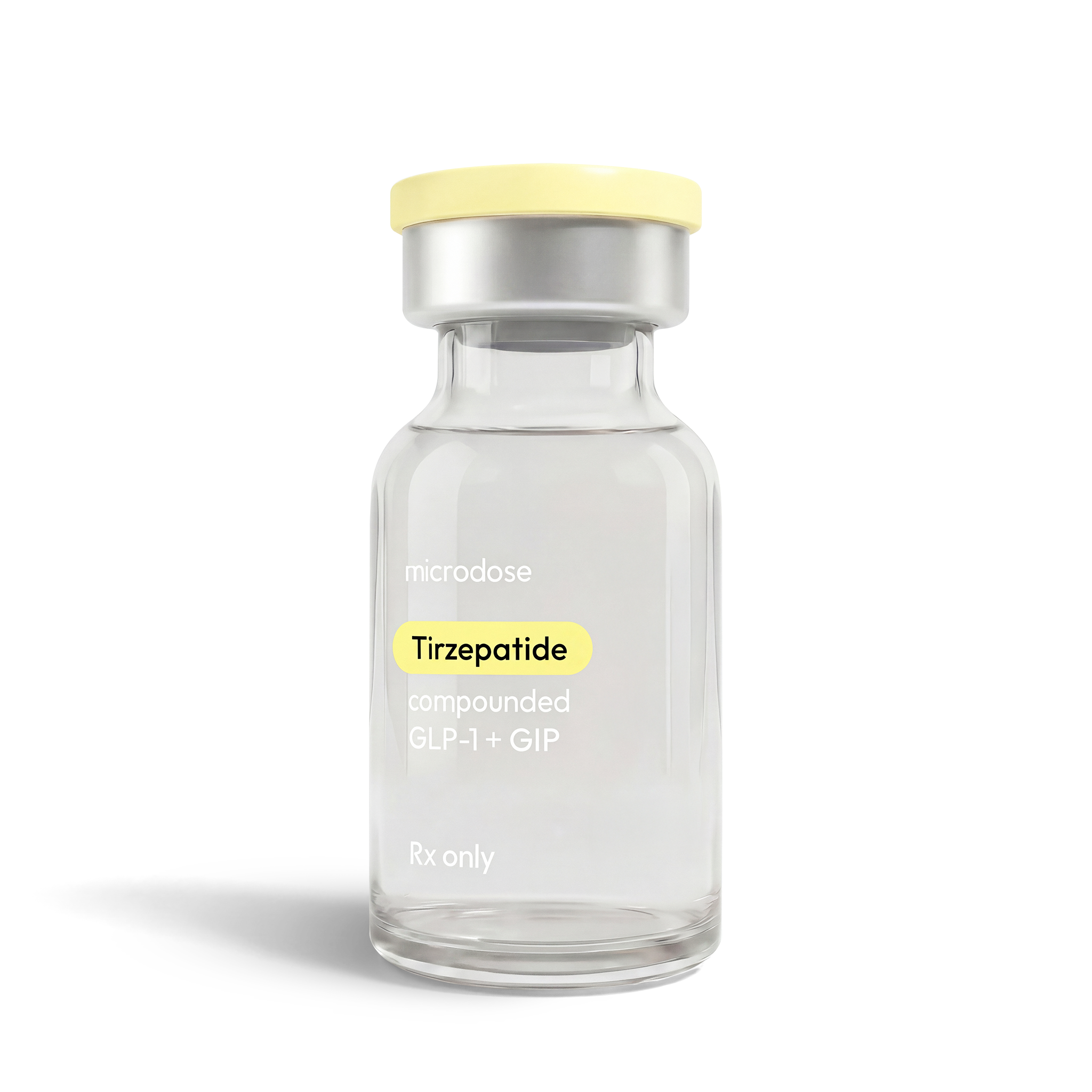
Tirzepatide adds a second mechanism. By also activating GIP (glucose-dependent insulinotropic polypeptide) receptors, it engages an additional pathway involved in energy regulation and fat metabolism, which may contribute to the more pronounced appetite reduction many tirzepatide patients report compared to semaglutide.
The Early Weeks: Why Nausea and Fatigue Happen
Understanding why GLP-1 therapy works makes the early side effects easier to interpret, and easier to get through.
Nausea is the most commonly reported early symptom, and it’s directly related to the mechanism that makes the medication effective. Slowed gastric emptying means food sits in the stomach longer. For a digestive system that has spent years processing meals at a certain pace, that change requires adjustment. The nausea most patients experience in the first one to three weeks isn’t a sign the medication isn’t working. It’s a sign that it is.
For most patients, that nausea improves significantly within the first month. The practical strategies that help most folks are straightforward: smaller meals eaten more slowly, avoiding high-fat or heavily spiced food, staying upright after eating, and keeping something small in your stomach before the medication has a chance to hit on an empty one.
Fatigue is more varied in its causes. Some of it is simply the body adjusting to a significantly different caloric intake. Some of it reflects the loss of the blood sugar peaks and valleys that come with a high-carbohydrate diet: peaks that feel like energy in the moment and crashes that feel like the need for more food. As the body shifts to a more stable metabolic pattern, the initial adjustment can feel like low energy, even as overall health is improving.
The nutrition strategies that address fatigue most effectively come down to three things:
Protein timing matters more than most patients realize. Eating adequate protein (ideally distributed across meals rather than concentrated in one) helps preserve muscle mass during caloric restriction and supports steady energy. On GLP-1 therapy, when total food volume decreases, protein density becomes more important. Thirty grams per meal is a reasonable target for most patients, though individual needs vary.
Electrolytes deserve attention. Reduced food intake means reduced intake of sodium, potassium, and magnesium from food sources. Reduced appetite also reduces water intake for many patients. The headaches, muscle cramps, and general fatigue that some patients attribute to the medication are often partly a hydration and electrolyte issue. Adding an electrolyte supplement or being deliberate about potassium and magnesium-rich foods can make a meaningful difference in how patients feel during the adjustment period.
Micronutrient gaps close slowly. Eating significantly less means eating fewer vitamins and minerals overall. A basic multivitamin during the titration period isn’t a replacement for nutrient-dense eating, but it provides a floor that helps prevent the deficiencies that compound fatigue.
The Longer Arc: How Appetite Reframes Over Time
The side effects of GLP-1 therapy are front-loaded. The psychological shift in how patients relate to food tends to develop more slowly. And for many patients, it turns out to be the most significant change. Patients who have spent years in a difficult relationship with food (cycling through restriction, overeating, guilt, and resolution) often describe something unexpected after several months on GLP-1 therapy. Food becomes less emotionally charged. Things that used to feel like rewards start feeling more neutral. Eating becomes, for perhaps the first time in years, something that happens in response to hunger rather than something that manages mood, stress, or boredom.
This isn’t universal, and it doesn't happen automatically. The neurochemical shift that GLP-1 medications produce creates a window: a period of reduced food noise during which patients have more capacity to examine their relationship with eating and build different patterns. That window is most valuable when it’s used deliberately, which is one reason behavioral support alongside medication tends to produce better long-term outcomes than medication alone.
What GLP-1 therapy doesn’t do is resolve the underlying patterns permanently on its own. The medication reduces the signal. What patients build during the period of reduced noise is what determines how durable the change is.
Frequently Asked Questions
What Is Food Noise and How Do GLP-1 Medications Reduce It?
Food noise refers to the persistent, intrusive thoughts about food that occur outside of genuine physiological hunger. It's driven by dopamine reward circuitry that has become strongly associated with eating. GLP-1 medications reduce food noise by activating receptors in brain regions involved in reward processing, reducing the salience of food-related cues and quieting the mental preoccupation with eating that many patients describe as their biggest obstacle to weight management.
How Does Semaglutide Stop Cravings?
Semaglutide activates GLP-1 receptors in both the gut and the brain. In the gut, it slows gastric emptying, extending the physical sensation of fullness. In the brain, it acts on reward and satiety pathways that regulate appetite and food-related motivation. The combined effect reduces both physical hunger and the neurological pull toward food that exists independent of caloric need.
Why Does GLP-1 Therapy Cause Fatigue?
Early fatigue on GLP-1 therapy typically reflects the body adjusting to reduced caloric intake, changes in blood sugar regulation, and reduced intake of fluids and electrolytes from food. Most patients find it improves within the first few weeks. Supporting adequate protein intake, staying well hydrated, and monitoring electrolytes, particularly sodium, potassium, and magnesium, addresses the majority of fatigue that patients experience.
How Long Does Nausea Last on Semaglutide or Tirzepatide?
For most patients, nausea is most pronounced in the first one to three weeks of treatment and improves significantly as the body adjusts to slowed gastric emptying. Eating smaller meals more slowly, avoiding high-fat food, and not lying down immediately after eating all reduce nausea. If nausea is severe or persistent beyond the first month, it's worth discussing with your clinician, dose timing or titration pace may need adjustment.
Does GLP-1 Therapy Change Your Relationship With Food Permanently?
GLP-1 medications create a neurochemical shift that reduces food noise and the emotional charge around eating for many patients. Whether that shift becomes durable depends largely on what patients build during the period of reduced noise. Behavioral patterns developed while appetite is quieter, different relationships with portion size, stress eating, and food as reward, tend to persist more than the neurochemical effect alone. Long-term outcomes are generally better when medication is combined with behavioral support.
Is Tirzepatide Better Than Semaglutide for Reducing Food Noise?
Clinical trial data suggests tirzepatide produces greater average weight loss, and many patients report more pronounced appetite suppression with tirzepatide than semaglutide. This may relate to its dual GLP-1 and GIP mechanism, which engages additional pathways involved in energy regulation. Whether that translates to more significant food noise reduction specifically hasn't been directly compared in published research. Individual responses vary considerably for both medications.
Bibliography
- Blundell, J., Finlayson, G., Axelsen, M., Flint, A., Gibbons, C., Kvist, T., & Hjerpsted, J.B. (2017). Effects of once-weekly semaglutide on appetite, energy intake, energy expenditure, glucose metabolism, and body composition in adults with overweight or obesity. Diabetes, Obesity and Metabolism, 19(9), 1242-1251. https://dom-pubs.onlinelibrary.wiley.com/doi/10.1111/dom.12932
- van Can, J., Sloth, B., Jensen, C.B., Flint, A., Blaak, E.E., & Saris, W.H.M. (2014). Effects of the once-daily GLP-1 analog liraglutide on gastric emptying, glycemic parameters, appetite and energy metabolism in obese, non-diabetic adults. International Journal of Obesity, 38(6), 784-793. https://www.nature.com/articles/ijo2013162
- Müller, T.D., Finan, B., Bloom, S.R., D'Alessio, D., Drucker, D.J., Flatt, P.R., Fritsche, A., Gribble, F., Grill, H.J., Habener, J.F., Holst, J.J., Langhans, W., Meier, J.J., Nauck, M.A., Perez-Tilve, D., Pocai, A., Reimann, F., Sandoval, D., Schwartz, T.W., ... Tschöp, M.H. (2019). Glucagon-like peptide 1 (GLP-1). Molecular Metabolism, 30, 72-130. https://www.sciencedirect.com/science/article/pii/S2212877819308786
- Jastreboff, A.M., Aronne, L.J., Ahmad, N.N., Wharton, S., Connery, L., Alves, B., Kiyosue, A., Zhang, S., Liu, B., Bunck, M.C., & Stefanski, A. (2022). Tirzepatide once weekly for the treatment of obesity. New England Journal of Medicine, 387(3), 205-216. https://www.nejm.org/doi/full/10.1056/NEJMoa2206038
- Berthoud, H.R., Münzberg, H., & Morrison, C.D. (2017). Blaming the brain for obesity: Integration of hedonic and homeostatic mechanisms. Gastroenterology, 152(7), 1728-1738. https://www.gastrojournal.org/article/S0016-5085(17)30189-8/fulltext
- Wharton, S., Lau, D.C.W., Vallis, M., Sharma, A.M., Biertho, L., Campbell-Scherer, D., Adamo, K., Alberga, A., Bell, R., Boule, N., Boyling, E., Brown, J., Calam, B., Clarke, C., Crowshoe, L., Divalentino, D., Forhan, M., Freedhoff, Y., Gagner, M., ... Wicklum, S. (2020). Obesity in adults: A clinical practice guideline. CMAJ, 192(31), E875-E891. https://www.cmaj.ca/content/192/31/E875



.svg)

.svg)